Ad Jesum per Mariam

Ad Jesum per Mariam
...if you genuinely wish to reach a high level of prayer in all honesty and without falling into the traps that the devil sets for those who pray, SAY your Rosary everyday... St. Louis-Marie Grignion de Montfort
Showing posts with label Meditation. Show all posts

Thursday, November 14, 2013

The Second Coming and The Destruction of All (Luke 17:26-37 The Days of the Son of Man)

The Proclamation of the Holy Gospel according to St. Luke (Luke 17:26-37)

26 'As it was in Noah's day, so will it also be in the days of the Son of man.
27 People were eating and drinking, marrying wives and husbands, right up to the day Noah went into the ark, and the Flood came and destroyed them all.
28 It will be the same as it was in Lot's day: people were eating and drinking, buying and selling, planting and building,
29 but the day Lot left Sodom, it rained fire and brimstone from heaven and it destroyed them all.
30 It will be the same when the day comes for the Son of man to be revealed.
31 'When that Day comes, no one on the housetop, with his possessions in the house, must come down tocollect them, nor must anyone in the fields turn back.
32 Remember Lot's wife.
33 Anyone who tries to preserve his life will lose it; and anyone who loses it will keep it safe.
34 I tell you, on that night, when two are in one bed, one will be taken, the other left;
35 when two women are grinding corn together, one will be taken, the other left.'
36
37 The disciples spoke up and asked, 'Where, Lord?' He said, 'Where the body is, there too will the vultures gather.'
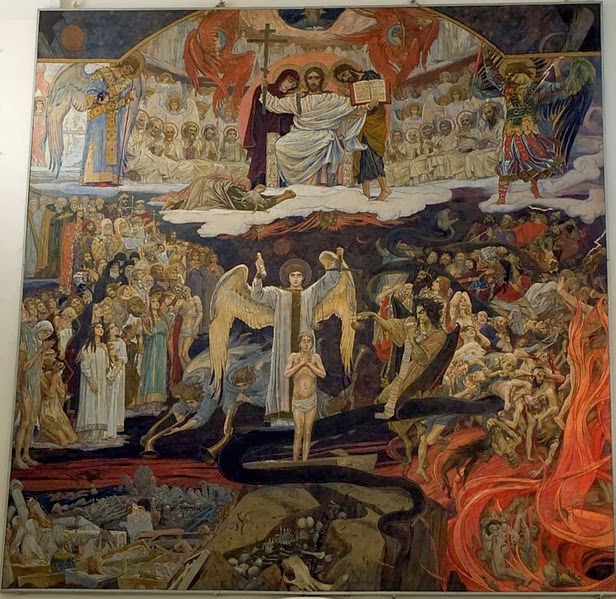
The Gospel of St. Luke tells us how the Son of Man will come, the Parousia, or the Second Coming of Christ. It will be like in the days of Noah, where the people live in sin, wickedness, corruption of mind and heart, and full of lawlessness. God will come like a great flood, destroying everyone and everything that is wicked.

It is like a baptism. That's why we are called to live the baptismal promises we made - the baptism which we are baptized. We should live blameless in the sight of God by living the "great flood in the days of Noah" that was poured in us when we are baptized - with water and the Holy Spirit. That's how important our living the baptismal promises that we made. Because in the end, we do not know exactly when the Son of Man will come, and we do not even know when our earthly life will will end.

It is very fitting here to add the words of a saint who said, "Work out your salvation with fear and trembling." But we must balance it with the words of St. Francis de Sales: "We should fear God out of love; not love Him out of fear."

The coming of the Son of Man is similar in the days of Lot where the people are full and busy of themselves. The great problem also was sin is reigning in them where immorality and homosexuality was a way of living. Again, God will come and His revelation of self will be like a raining sulphurous fire that destroyed Sodom and Gomorrah. Here, we see how to live the fire, the sulphurous fire-like grace that we received in the Sacrament of Confirmation. The Holy Spirit will help us now to be in flames burning, dedicated to God and His Gospel. Just like the Sacrament of Baptism, we are much more called here to boost our all to live the baptismal promises we made more fully.

The Gospel tells also that we must not be attached to material possessions and the things that seems important to us. We are called to a total detachment from things - everything that has no concern with the coming of the Lord. We must not be like Lot's wife, who looked back, and was turned into a pillar of salt (Genesis 19:26). Again, we are called to a total detachment from all and a total attachment to God alone.

Like the salt, we must be preserved in sanctity and righteousness. Unlike the wife of Lot who looked back or turned back in the sight of destruction of Sodom and Gomorrah, we must not look or turn back from sin, wickedness, corruption, and lawlessness once we dedicate ourselves to God, because if we do so, we will be like the wife of Lot who became a pillar of salt. Again, we must be like salt.

Let us live lives pleasing to the Lord so that we will be taken by Him and not be left for destruction.

And "where the body is, the vultures will gather." For people who are concerned with the satisfaction of the body, succumb into concupiscence and irascible passions, like vultures, they will gather into a body - left in corruption and full of filth, all of them will be destroyed.

Here are some points to consider:

1. Live your own vocation vigilantly.

2. Live your baptismal promises faithfully, honestly, with loyalty and fidelity.

3. Be a "living Gospel."

4. Be prepared always. (For you don't know when you will be killed! Joke!)

5. We must embrace a life of total detachment from everything (even human attachments) and live a life of total attachment to God alone.

6. We must be holy as the Heavenly Father is holy.

7. We must remember that there are times of feasting, and there are times of fasting.

8. We must give our spiritual faculties (soul) a lot more attention than bodily faculties.

"Jesus, I trust in You." "O Mary conceived without sin, pray for us who have recourse to thee."

Ad Majorem Dei Gloriam!


Mary H. Distributist


Pharisees Not Damned! And the Parousia (Luke 17:20-25)

20 Asked by the Pharisees when the kingdom of God was to come, he gave them this answer, 'The coming of the kingdom of God does not admit of observation
21 and there will be no one to say, "Look, it is here! Look, it is there!" For look, the kingdom of God is among you.'
22 He said to the disciples, 'A time will come when you will long to see one of the days of the Son of man andwill not see it.
23 They will say to you, "Look, it is there!" or, "Look, it is here!" Make no move; do not set off in pursuit;
24 for as the lightning flashing from one part of heaven lights up the other, so will be the Son of man when his Day comes.
25 But first he is destined to suffer grievously and be rejected by this generation.

In this Gospel story of St. Luke, we were told that the Pharisees asked the Lord when the Kingdom of God would come. This question of the Pharisees is very peculiar or mysterious for it seems that they do not know what the Kingdom of God is, they are asking the Lord when it would come. I think the Lord Jesus is laughing interiorly in this question of the Pharisees. We can imagine that Jesus Christ thought to Himself: "What an unintelligible question from you, Pharisees! Do not you know that the Kingdom of God existed before and still exists, and the Kingdom of God is within you? Among you? Existing in the midst of you? Reigning among you?" Jesus Christ may seem taken aback and lowered His eyebrows because, of the Pharisees' question. The Lord can't believe what was asked of Him! He can't imagine that such "holy" persons like the Pharisees will ask Him that question! Maybe Jesus Christ thought that the Pharisees were joking, for the Lord seemed read their minds that they are imagining that the Kingdom of God will be sent from heaven like a descending palace, like a descending helicopter, landing on earth. The Pharisees were looking and in search of the manifestation of the Kingdom of God. They are in search of something that will tell to them that, "Ah! Here is the Kingdom of God! Here it is! It is now here! It came! Let us rush and welcome and receive the Kingdom of God!
But they are completely wrong for the Lord replied that the coming of the Kingdom of God, the Kingdom of heaven, and the Kingdom of the Lord cannot be observed. Why? Because the Kingdom is here already! The Kingdom existed and still exists before the Pharisees eyes and senses! Why? Because the Kingdom of God is within you! Among you! 
Don't search for it! All you have to do is to be sensitive enough that the Kingdom of God is now here! It is within you! 
It is very peculiar and mysterious also that the Lord Jesus Christ did not become angry to the Pharisees. The Lord was somewhat in good mood towards them. The Gospel is indeed a funny one! The Lord Jesus is gentle indeed. He answered them calmly and peacefully and in a very friendly way: "For behold, the Kingdom of God is among you." What a mystery! What a miracle! We know that the Pharisees were the Lord Jesus "hated" in His time. They are also the "suki" or receiver of the Lord's wrath and anger and sermons and thundering words that makes their faces turn to red of shame and disgust from the "arrogance" of the Lord. But in the Gospel story, what a contrast! He answered them that the Kingdom of God is among or within the Pharisees! Wow! I can't believe it! What is the meaning of this?
We know that the Pharisees are the priests of the Lord that time. We know that they are the Church authorities before. But still, despite their hardness of heart, they are still the priest of God. They are still the one who works for God. They are still the priests of God - Whom God also loves. God loves them also. God loves the Pharisees despite of their stubbornness. They are still God's priests! It is indeed true, that the Kingdom of God is within us and among us! The Kingdom of God - of Love and Mercy is among us!
Then we are told of St. Luke that the Lord turned and said to His disciples that the days will come when they will remember the Lord Jesus' days here on this earth. They will longingly hope for the Lord - for His coming and His glory. 
In here He warned them that they must be on guard and vigilant against those false persons that tell that the Son of Man is here and came already - that is the Parousia - the Second coming of Jesus Christ. Jesus Christ showed them how frightening and majestic fear He would come in glory. The day of the Lord will indeed come, but it will not be determined by false prophets and false witnesses. But the Lord Jesus Christ also added that before these things will happen, "first he must suffer greatly and be rejected by this generation." He will suffer greatly from the Pharisees He answered with gentleness in the first story of the Gospel, he will also suffer from His disciples - all of them will be the cause of God's great suffering. Jesus Christ will be rejected so that the prophesy might be fulfilled: "The Lord rejected by the builder has become the cornerstone."
Here are some points to consider:
1. The Kingdom of God is among us. If it is so, and truly is, then it is up to us if we will surrender to God ourselves for His Kingdom and to serve Him. Let us live righteous lives in order to be called worthily indeed the Kingdom of God is among us.
2. We must be sensitive enough that the Kingdom of God is among us. 
3. Let us be on guard and vigilant against the false prophets and false witnesses.
4. Let us go to the Sacrament of Confession (confess your mortal sins!) and solidly live not to sin mortal sins again - this will strengthen the Kingdom of God and will mitigate the hurts the Lord Jesus receives from all of us - the sins that hurts Him and His Body, the Church.
5. Let us not reject Jesus Christ. Let us allow him to live in us because He is for us. "If God is with us, who can be against us?"
6. Let us longingly hope for the glorious coming of the Lord! Let us do it with vigilance.
"Jesus, I trust in You." "O Mary conceived without sin, pray for us who have recourse to thee."
Ad Majorem Dei Gloriam!


Mary H. Distributist


What An Attitude of a Servant! (Luke 17:7-10 Attitude of a Servant)

Attitude of a Servant

But which of you having a servant ploughing, or feeding cattle, will say to him, when he is come from the field: Immediately go, sit down to meat: [8] And will not rather say to him: Make ready my supper, and gird thyself, and serve me, whilst I eat and drink, and afterwards thou shalt eat and drink? [9] Doth he thank that servant, for doing the things which he commanded him? [10] I think not. So you also, when you shall have done all these things that are commanded you, say: We are unprofitable servants; we have done that which we ought to do.


Jesus Christ gives his apostles a story giving them a right to be "masters" of a servant that He chose to be an example for them - even if it just a story - I believe there is a hidden humor in this Gospel - at least Lord Jesus let the apostles feel and experience how to be masters, to be masters even if it is just in a story made by the Lord.

"Who among you would say to your servant who has just come in from plowing or tending sheep in the field, 'Come here immediately and take your place at table'?

These words let the apostles imagine they are the masters. They were thinking that how lucky the servant if he will be treated just like that - even after the servant is surely exhausted or dead tired returning from plowing or tending sheep in the field which is a very tiring work to do - laborious in "bloody" terms.

Imagine the apostles’ reaction after hearing these words from the Lord. Surely you will think that the apostles will get angry to the servant Jesus Christ portrays to them - in a story.

"Feeling lucky, punk!", says the apostles to the servant - of the story.

But in reality, although it may seem that the Gospel do not show compassion, mercy, love, care, humane or brotherly love, nor warmth the master have toward his servant, actually it is really how a master treats his servant.

We must know the analogy - when the story applies to God as master and the apostles as His servants. That's how God will treat His servants. It may seem inhumane or "capitalistic", but that Gospel story shows how it is really to be a master, and how it is really to be a servant. Different from this world who some aspires to establish a communist ideology which will imaginary lead to brotherhood and equality.

Jesus Christ added, "Would he not rather say to him, 'Prepare something for me to eat. Put on your apron and wait on me while I eat and drink. You may eat and drink when I am finished'?

So humorously, the apostles who became masters of the servant had high hopes to be boastful, for Jesus Christ provided words for them that they will use as command to the servant - in the imaginary story.

Here, we see how a master treats his servant. The master commands. The servant has an obligation - to be obedient to the master and his command. The servant is still a servant of the master. He does what is commanded of him. He serves the
master even if his stomach is revolting against itself - even if he is dead tired from laborious work. He puts on the apron, that is, the working clothes that shows his servant hood and his readiness to do the commands demanded of him by the
master. He waits for the master. The servant is prepared and on standby as part of his servant hood. And after the master is finished from his eating and drinking, here goes the reward for his fidelity, faithfulness, and loyalty to the master and his
commands or master's words. He can eat and drink as commanded; the servant undeservingly receives his food and drink! He is undeserving of these things.

"Is he grateful to that servant because he did what was commanded? So should it be with you." Here, humorously, ends the "master hood" of the apostles when our Lord Jesus Christ said the words, "So should it be with you." The apostles
sighed for they are really servants, and Jesus Christ is their Master - and there is no other.

God and the master of the Gospel story shows gratitude and thankfulness towards the servant, for the servant did what was commanded of him.

But still, the servant is nothing and deserves nothing.

"When you have done all you have commanded, say, 'We are unprofitable servants; we have done what we were obliged to do.'"

The master will be more grateful or thankful to the servant if this is his attitude - because he is really nothing and deserves nothing, and the servant knows this. That is also a command from the Lord Jesus, to say those words He said!

Here are some points worth considering:

1. We are not masters. We all have but only one Master and that is Jesus Christ.

2. We are all servants. Therefore we must have a proper attitude a servant has.

3. We must have the attitude of self-emptiness, self-nothingness, and self-forgetfulness as servants. We must be obedient, humble, prepared, and careful in listening.

4. We must not be assuming. Remember we are servants.

5. We should say always as what was commanded of us by Jesus Christ, "We are unprofitable servants; we have done what we were obliged to do."

Ad Majorem Dei Gloriam!


Mary H. Distributist


Wednesday, November 13, 2013

Sensitivity, Gratefulness, Knowledge, Faith (Luke 17:11-19 The Cleansing of the Ten Lepers)

The Cleansing of the Ten Lepers (Luke 17: 11-19)

And it came to pass, as he was going to Jerusalem, he passed through the midst of Samaria and Galilee. [12] And as he entered into a certain town, there met him ten men that were lepers, who stood afar off; [13] And lifted up their voice, saying: Jesus, master, have mercy on us. [14] Whom when he saw, he said: Go, show yourselves to the priests. And it came to pass, as they went, they were made clean. [15] And one of them, when he saw that he was made clean, went back, with a loud voice glorifying God.
[16] And he fell on his face before his feet, giving thanks: and this was a Samaritan. [17] And Jesus answering, said, Were not ten made clean? and where are the nine? [18] There is no one found to return and give glory to God, but this stranger. [19] And he said to him: Arise, go thy way; for thy faith hath made thee whole.

"17 This led Jesus to say, 'Were not all ten made clean? The other nine, where are they?
18 It seems that no one has come back to give praise to God, except this foreigner.'"
According to St. Luke the evangelist, Our Lord Jesus Christ continued his journey to Jerusalem, travelled between Samaria and Galilee.

We may firmly believe here that our Lord met many people and graced them by His presence.

As He was entering a village, we are told, that ten lepers met him. They stood at a distance from him for they bear leprosy in their own selves. But their condition did not became a hindrance on crying out to God, to our Lord Jesus who hears the cry of the poor and the afflicted ones who were abandoned, deprived of love, mercy, and compassion from the rest of the world, those who are cast out from the rest.

They raised their voice saying, "Jesus, Master! Have pity on us!" They know that God will pity them and by faith knows that God will save them from their condition.

Lord Jesus in turn listened, heard their cry and pitied them, gave them a mysterious command to go and show themselves to the priests. They did go and as they are going, they were cleansed. And one of them, realizing he had been healed, sensed that God saved him from his affliction, the Eternal High Priest healed him from
his leprosy, understood that God is the priest - the only priest that heals and saves. In realizing that God healed him (even without the assurance of the healing words of God but in obedience to the Lord they left Him to present themselves to the priests), it shows that he is sensitive enough to know to whom he must be thankful for. He knew to whom he should give glory - to God alone. He intensified his
voice much louder than the first cry he made when he is pleading to God for mercy. He returned the healing he received from God by returning himself - his whole self to God giving the Lord the homage He deserves and, he did this with humility, self-emptiness, and gratitude.

The Lord is merciful and loving even to those people whose identity and race is detestable - just like this Samaritan leper. He acknowledges the fact Jesus is the Lord, God, and Master and he knew by faith that he will be healed by this Eternal High Priest who is a Jew. The Samaritan leper became a Jew - for he returned to God and acknowledged Him who is the One True God - the Only Healer and Savior - the One and the Only Priest - the Eternal High Priest.

Jesus Christ seemed amazed by the return of the Samaritan leper where in fact, He healed ten lepers. He is inquiring for the nine who were insensitive and ungrateful to God. But the Samaritan just did what he ought to do - he stayed at the feet of Jesus Christ giving homage and gratefulness, not minding the other nine - he is enjoying the moment with Him.

Jesus Christ in turn said to the thankful man, "Be my rejoicing disciple who will be my witness of healing and life. Your faith has saved you from your iniquities."

We must consider the following:

We must return to God with rejoicing and thankfulness for He saved us from sin and death and from the fruits of these.

We must acknowledge Him as the One and Only Eternal High Priest and there's no other.

We must know and realize that God is the Only Healer and Savior and there is no other.

We must be sensitive and grateful enough to realize whom we must be thankful for - God alone.

We must be solid in our faith in God.

We must empty ourselves from ourselves to be humble enough and grateful enough to God

Ad Majorem Dei Gloriam!


Mary H. Distributist


Tuesday, October 15, 2013

Effective, Powerful Praying With Blessed Virgin Mary

Let us not fool ourselves. The praying of the holy Rosary of the Blessed Virgin Mary is really the hardest prayer to pray for not only the words of it were one and the same, it is also far more different to other prayers who have "variety of words and expressions which keeps us alert, prevents our imagination from wandering, and so makes it easier for us to say them well." - The Secret of the Rosary, St. Louis-Marie Grignion de Montfort.


Now, let me share you a subjective, biased discovery and experience of mine while praying the holy Rosary (yes, subjective and biased for it's my personal experience and I do not want to impose this method to anyone. But you can do it also, if it is effective and fitting for you. But if not, pray that God, with the help of Mama Mary, show the most effective way of praying it).

Listening! Listening is the key in order to fight distractions and to still our lurking imagination when praying the holy Rosary!

What do I mean by this?

An inspiration (insight while praying) came into my mind that it is listening. And a thought also added in me : "How can you become a good spiritual director if you are not good in listening?"

Whoa! That's it! It is listening! In order for me to enjoy more fully and attentively the holy Rosary I must listen!

This is what I discovered also.

When I started to pray, I started with the sign of the cross, then next is the Rosary Confraternity prayer (which our "opening" prayer as members of the Confraternity of the Most Holy Rosary), then next is what I want or desire to pray for (what we call "petitions"), and then I will begin the holy Rosary proper : kissing the crucifix then making the sign of the cross, then the Creed (Apostle's, sometimes Nicene), then as usual, passing the beads in my thumb and index finger with respect to the bead's corresponding prayer.

Then I listen to the words I pray - by the way, it starts on the beginning of your praying of course. I reiterate! It is listening! Listen to the words you say for those words are the Word of God and it's Jesus Christ Himself! The Word who became flesh!

The Our Father or the Lord's prayer came from Jesus Christ's own mouth. The Hail Mary or the Angelic Salutation came also from God and the messenger is just St. Gabriel. Savor every words of the holy Rosary. Savor it by listening! Just listen! And savor the words!

Now, listening and imagination must go hand in hand here. It is important to meditate (think over) about the sacred mysteries of the holy Rosary. As you listen to the Hail Mary's, imagine the sacred mysteries by, of course, your mind. My imagination has a very important role when praying. Here, I exercise the command of our Lord. "Love God...with all your mind."

The listening and imagining must get along with each other, making a harmonious exaltation of both mind and heart. The words are for listening, while the sacred mysteries are the word's soul and meaning.

While saying the Hail Mary, listen to the words. Then at the background, let the sacred events pass or play in your mind. Pay attention to everything - savor everything. Make an exercise now!

The holy Rosary is the second highest prayer next to the Holy Mass and devotion to the Most Blessed Sacrament of our Lord. Please remember that.

So the elements present in praying the holy Rosary are the following :
1.) Listening
2.) Saying
3.) Imagining

May you love the holy Rosary everyday just like me.

Go and set the world on fire!

ADMG

Mary H. Distributist